
Demand - Led School Planning - Start with Demand, Not LandWhy demand, demographics, and fee capacity must shape decisions before land or infrastructure
In the Indian K–12 ecosystem, one of the most common strategic errors is beginning a school project with land acquisition. While land feels tangible and decisive, it is also the most capital-intensive and least flexible decision. Schools, however, are not real estate projects—they are demand-driven institutions.
A more effective approach is demand-led planning, where market demand, demographic realities, and fee-paying capacity guide every critical decision before any capital is committed. This approach significantly reduces risk and improves long-term sustainability.
Understanding Demand-Led Planning
Demand-led school planning is about reversing the traditional sequence. Instead of asking “What can we build on this land?”, the right question is:
“What kind of school does this market need—and can sustain?”
This requires answering three core questions:
- Who are the potential students within the catchment?
- What are parents currently getting—and what are they missing?
- What fee levels can the market realistically support?
Only after these are clearly understood should decisions on land, infrastructure, and scale be taken.
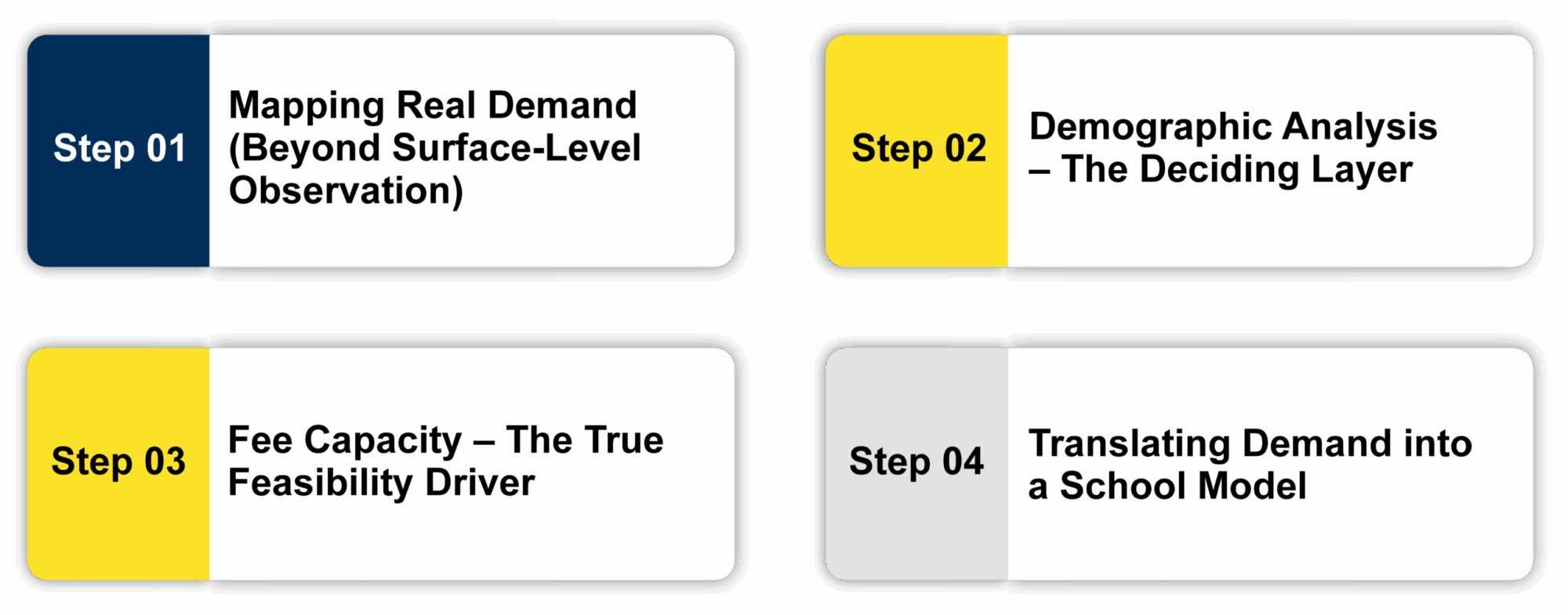
Step 1: Mapping Real Demand (Beyond Surface-Level Observation)
Demand assessment is not simply about seeing residential buildings nearby. It requires structured analysis of both current and future enrolment potential.
A school typically draws from a 30–45 minute travel catchment, making accessibility a defining factor. However, within this catchment, demand must be quantified using data, not assumptions.
Key demand indicators include:
- Population growth and upcoming residential developments
- Age-group distribution (especially 2–18 years)
- Existing school capacity versus actual enrolment
- Admission rejections and waiting lists
- Migration trends and urban expansion
Importantly, demand exists in two forms:
- Visible Demand (Supply Gap):
Where existing schools are full or inadequate, creating immediate enrolment opportunities. - Latent Demand (Aspirational Gap):
Where schools exist, but parents are seeking better quality, international exposure, or differentiated learning.
A successful school project identifies not just if demand exists, but what type of demand exists.
Step 2: Demographic Analysis – The Deciding Layer
Demand without demographic understanding often leads to incorrect positioning. Two areas may have similar population sizes but completely different expectations from a school.
Demographic profiling helps decode the nature of demand.
Critical demographic factors:
- Income levels: Determine fee ceilings and affordability
- Parent mindset: Traditional vs aspirational outlook
- Occupation patterns: Salaried, business, transferable jobs
- Education preferences: CBSE, ICSE, IB, or alternative models
For example, a premium international school cannot succeed in a price-sensitive catchment, just as a basic CBSE school may underperform in a high-income, aspirational area.
The school model must match the mindset and paying capacity of the catchment.
Step 3: Fee Capacity – The True Feasibility Driver
Fees are the primary revenue engine of a school, but more importantly, they determine the quality of delivery.
A common misconception is that fees can be decided later. In reality, fee potential must be assessed early because it directly impacts:
- Teacher salaries and retention
- Academic quality
- Infrastructure standards
- Overall brand positioning
Fee planning should be based on:
- Benchmarking nearby schools
- Household income and spending patterns
- Parent willingness to pay for education
- Competitive positioning
A mismatch between fees and local affordability leads to enrolment challenges, while underpricing compromises quality.
Sustainable fees are those that balance affordability with the ability to deliver excellence.
Step 4: Translating Demand into a School Model
Once demand and fee potential are clearly understood, the school model can be defined with precision.
This includes decisions on:
- Type of school (mass, premium, international, or niche)
- Curriculum and board affiliation
- Capacity and scale of operations
- Phased development approach
Instead of overbuilding upfront, a phased model aligned with enrolment growth ensures better financial control and adaptability.
Why Land Selection Must Follow Demand Validation
One of the most critical insights in demand-led planning is that land should be a consequence—not the starting point.
When land is acquired without understanding demand:
- The project may become financially unviable due to high capital costs
- The location may not align with the target audience
- Expansion may be restricted or unnecessary
- Regulatory and zoning challenges may arise
In contrast, when demand is validated first, land decisions become strategic.
Demand-led land finalization considers:
- Proximity to the identified catchment
- Required land size based on board norms (CBSE, ICSE, IB)
- Scope for future expansion
- Cost alignment with projected revenues
- Compliance with zoning and legal requirements
Financial Viability: The Final Checkpoint
Even with strong demand and appropriate fees, a project must pass the test of financial viability.
This involves aligning:
- Capital expenditure (land + construction)
- Operating costs
- Fee revenues
- Debt obligations
- Long-term returns
A well-planned school typically aims for:
- Breakeven within 5–7 years
- Minimum IRR of approximately 14–15% over 10–15 years
Demand creates the opportunity, but financial discipline ensures sustainability.
Conclusion: Build Schools from Insight, Not Instinct
Demand-led school planning is not just a methodology—it is a mindset shift. It replaces assumption-driven decisions with data-backed strategy.
By aligning:
- Demand
- Demographics
- Fee capacity
- Financial viability
before committing to land or infrastructure, promoters significantly increase the probability of success.