
Should You Open A School
Opening a school is often viewed as a noble, future-proof, and socially respected venture. Many promoters enter the education space believing that demand will always exist, fees will rise steadily, and quality education will eventually attract parents. While parts of this belief are true, they are dangerously incomplete.
A school is not a conventional business. It does not behave like real estate, retail, hospitality, or manufacturing. It is capital-intensive, regulation-heavy, emotionally demanding, and slow to stabilise. Before land is purchased, architects appointed, or affiliations explored, the most important question must be asked honestly:
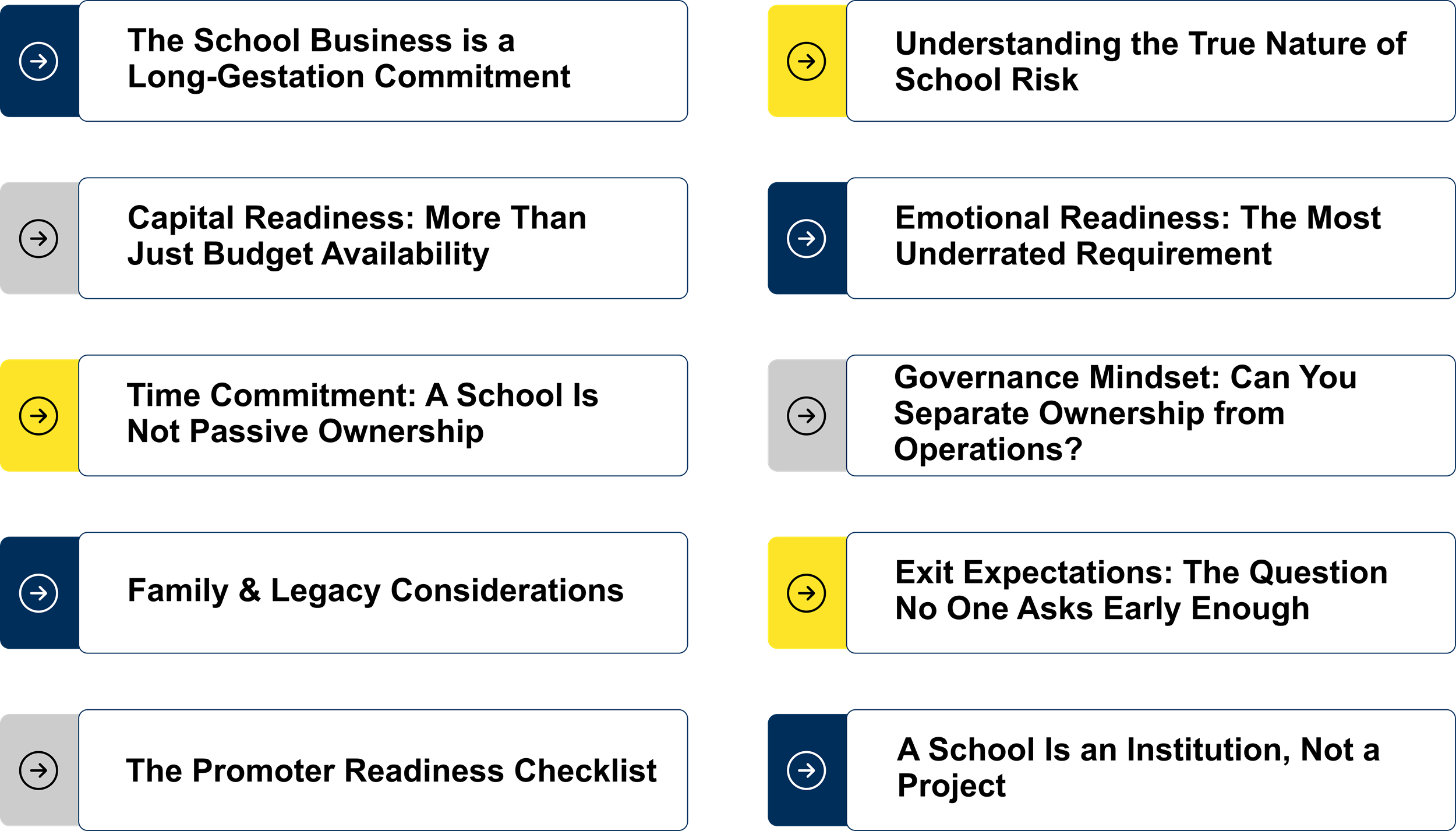
The School Business is a Long-Gestation Commitment
Unlike many businesses where results are visible within two to three years, schools function on academic cycles rather than financial quarters. Admissions occur once a year, brand credibility takes time to establish, and early missteps often compound quietly over multiple years.
Most schools require five to seven years to stabilise enrolments, seven to ten years to reach financial comfort, and more than a decade to feel institutionally mature. During this entire phase, promoters must continuously invest time, emotional energy, capital, and personal reputation. For those seeking quick returns, predictable exits, or passive income, the school business is fundamentally misaligned.
Understanding the True Nature of School Risk
School promoters often underestimate risk because education demand appears stable. While children will always need schools, there is no guarantee they will choose yours. The real risks in education are rarely dramatic failures; instead, they manifest as slow, persistent underperformance.
Enrolments may remain stuck at suboptimal levels, parents may resist fee increases, staff costs may rise without corresponding revenue growth, and minor incidents can quietly damage reputation. Regulatory uncertainty further compounds these challenges.
Unlike other businesses, schools cannot easily downsize or pause operations without reputational damage. Once launched, a school is expected to function continuously, regardless of enrolment levels. The real danger is not loss—it is stagnation.
Capital Readiness: More Than Just Budget Availability
Most promoters calculate the cost of land acquisition, construction, and initial setup, but very few account for capital patience. Schools typically experience negative cash flows in their early years and require ongoing reinvestment in staff, facilities, and marketing.
Capital is often locked into land and infrastructure with limited liquidity, and surplus generation is delayed. A critical question every promoter must ask is whether they can afford for this capital to remain illiquid for the next ten to fifteen years. Without this readiness, financial pressure can distort decision-making and compromise long-term outcomes.
Emotional Readiness: The Most Underrated Requirement
Schools are fundamentally people-driven institutions. Promoters are not managing products or transactions; they are managing parents, teachers, students, regulators, and public perception simultaneously.
Many underestimate the emotional demands involved, including parental entitlement, rapid amplification of issues through social media, recurring cycles of teacher dissatisfaction, community pressure, and heightened media sensitivity around schools.
Unlike most businesses, schools operate under constant moral scrutiny, where decisions are judged socially and emotionally, not just commercially. Promoters who take criticism personally, struggle with public complaints, expect gratitude for their investment, or find conflict emotionally draining often find the school business exhausting and unsustainable.
Time Commitment: A School Is Not Passive Ownership
A common misconception among first-time promoters is that hiring a principal makes a school self-running. In reality, during the first five to seven years, promoters must remain actively involved in admissions strategy, fee positioning, leadership selection and evaluation, conflict resolution, capital decisions, and reputation management.
Schools tend to fail when promoters are either excessively involved in academics, completely absent from governance, or inconsistent in decision-making. An honest self-assessment is essential: if your primary business already demands full attention, the school will inevitably suffer.
Governance Mindset: Can You Separate Ownership from Operations?
Schools demand a governance mindset rather than an ownership mindset. Promoters who struggle often micromanage teachers, impulsively override professional leadership, frequently change direction, or personalise institutional decisions.
Conversely, those who disengage entirely also risk failure. Successful promoters set clear vision, boundaries, and accountability structures, appoint strong leadership, review performance systematically, and intervene selectively and strategically. If delegating authority feels uncomfortable, or if holding professionals accountable creates friction, governance challenges will persist.
Family & Legacy Considerations
Many school projects are driven by family decisions, which introduces additional layers of complexity. Multiple decision-makers, differing expectations, unclear succession plans, and emotional ownership often complicate governance.
Before starting, promoters must clearly define who will actively manage the school, who will remain outside daily operations, whether the next generation has genuine interest, and how disagreements will be resolved. Schools often outlast their founders, and unresolved family alignment issues tend to surface later—often at great institutional cost.
Exit Expectations: The Question No One Asks Early Enough
One of the most difficult yet necessary questions is how and when a promoter intends to exit the venture. Unlike other businesses, schools are difficult to sell, have limited buyer pools, involve subjective valuations, and face complex regulatory transfer processes.
Most promoters exit only through asset monetisation, long-term management transfer, or family succession. If the investment logic depends on a clean financial exit within a defined timeframe, the education sector may not align with those expectations.
The Promoter Readiness Checklist
Before proceeding, promoters must reflect honestly on their readiness. This includes comfort with long gestation periods, independence from school cash flows for survival, emotional resilience under public scrutiny, the ability to dedicate sustained governance time, willingness to work with professionals without micromanaging, acceptance that a school is an institution rather than a product, and comfort with limited exit options.
A School Is an Institution, Not a Project
Schools punish impatience and reward consistency. Success is not determined by owning the best land, building the largest campus, or hiring the most expensive consultants. It belongs to promoters who enter with clarity, plan conservatively, govern patiently, remain emotionally balanced, and build trust year after year.
Opening a school is not about creating a building or launching a brand; it is about building an institution designed to outlive its founders.